


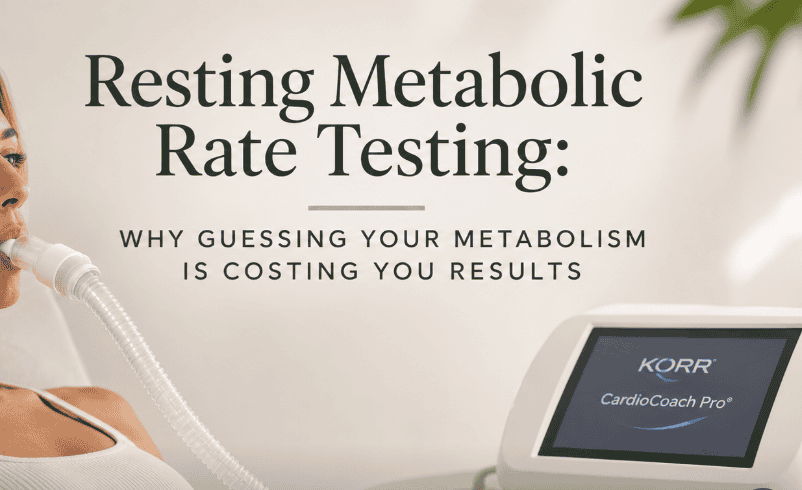
If you’ve ever plugged your age, height, and weight into an online calculator to find out how many calories you should eat, or glanced at your smartwatch to see “calories burned” for the day, you’ve been given an estimate — not a measurement. And when it comes to something as central to your health as your metabolism, that distinction matters enormously.
At Arizona Wellness Medicine, we believe that effective weight management, whether your goal is fat loss, maintenance, or healthy weight gain, starts with real data about your body, not a generic formula built for the “average” person. That’s why we offer Resting Metabolic Rate (RMR) testing in our office using the KORR Cardio Coach Pro, a clinical-grade metabolic testing system that measures — rather than estimates — exactly how many calories your body burns at rest.
What Is Resting Metabolic Rate Testing?
Your resting metabolic rate is the number of calories your body burns each day just to keep you alive: breathing, circulating blood, regulating temperature, repairing tissue, and running every basic cellular process. For most people, RMR accounts for 60 to 75 percent of total daily calorie burn, making it by far the biggest piece of the energy puzzle.
RMR testing is a simple, noninvasive procedure. You breathe normally into a mouthpiece for several minutes while resting quietly, and the equipment analyzes the air you inhale and exhale. No blood draws, no needles, and no strenuous activity involved. In under fifteen minutes, we can tell you precisely how many calories your body burns at rest.
How the Technology Works
RMR testing is based on a well-established science called indirect calorimetry. Rather than guessing your metabolism from a formula, indirect calorimetry measures it directly by analyzing your oxygen consumption, since the amount of oxygen your body uses is directly proportional to the number of calories you’re burning.
The Cardio Coach Pro we use in our office does this with a galvanic fuel cell oxygen sensor accurate to within 0.2 percent, paired with a precision airflow sensor that measures the volume of every breath. Because it also captures carbon dioxide output, it can calculate your respiratory exchange ratio, which tells us not just how many calories you’re burning, but whether your body is drawing more heavily from fat or carbohydrate stores at rest. The system self-calibrates for barometric pressure, temperature, and humidity before every test, and the underlying technology has been independently validated at research institutions including the University of Southern California and Oregon State University against mixing-chamber methodology, the gold standard for this type of testing. In practical terms, that means the number we hand you isn’t a ballpark. It’s a clinically validated measurement of your unique physiology.
What an RMR Report Looks Like
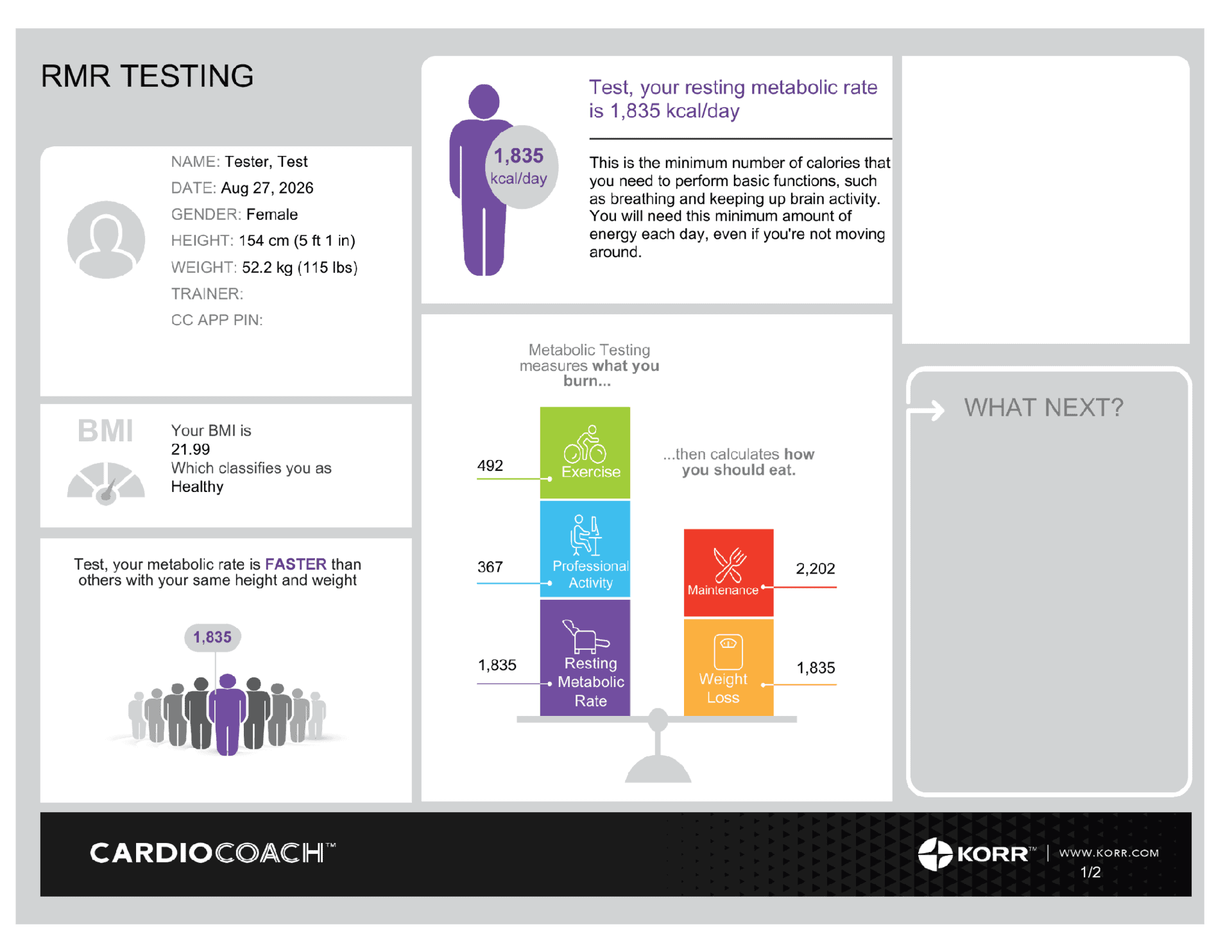
To make this concrete, here’s an actual sample report generated by the Cardio Coach Pro system we use in our office (the name and identifying details shown are placeholder demo data, not a real patient). Within minutes of finishing your breathing test, you receive a clear breakdown of your measured resting metabolic rate, how it compares to others of your same height and weight, and how that number translates into a maintenance calorie target and a weight-loss calorie target, all built from your own measured data rather than a formula.
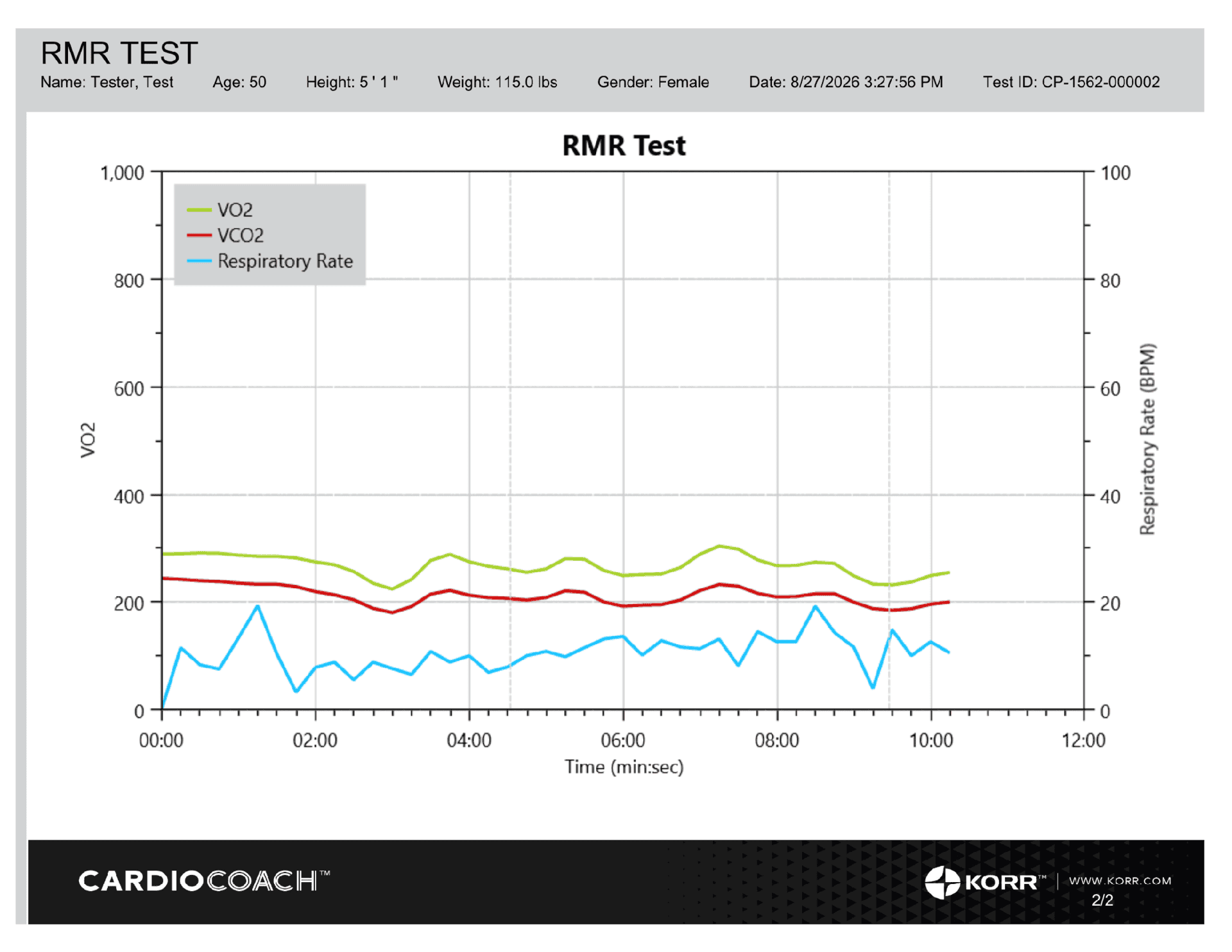
Underneath that summary sits the raw data the test actually captures: breath-by-breath oxygen consumption (VO2) and carbon dioxide production (VCO2) measured continuously throughout the test, along with your respiratory rate. This is the direct physiological measurement described above, indirect calorimetry in action, rather than an estimate derived from a formula or an algorithm.
Why This Beats Fitness Trackers and Smart Scales
It’s tempting to rely on the calorie counts from your Apple Watch, Fitbit, or the “metabolic age” reading on a bathroom smart scale. Unfortunately, those numbers are far less reliable than most people realize.
Fitness trackers estimate calorie burn using generalized algorithms built from your heart rate, steps, age, and weight. They aren’t measuring your metabolism at all; they’re comparing you to population averages. Independent research has found error rates as high as 35 percent for popular wearable devices when it comes to estimating energy expenditure, and those algorithms don’t account for individual differences in muscle mass, hormone status, or metabolic health.
Smart scales have a similar limitation. They use bioelectrical impedance, sending a faint electrical current through your body to estimate body composition, and then plug that estimate into a predictive formula to guess your metabolic rate. Because the reading depends heavily on your hydration status, what you last ate, and even the time of day, results can shift noticeably from one morning to the next despite nothing meaningful having changed in your body. Studies evaluating these devices consistently find that while they can track weight accurately, their estimates of body composition and metabolic rate carry substantial error.
Even the predictive equations doctors and dietitians have relied on for decades, like the Mifflin-St Jeor or Harris-Benedict formulas, fall short for the same reason: they were built from population averages and were never designed to capture an individual’s actual physiology. Published research comparing these formulas to measured RMR has found that, depending on the population studied, as few as 40 percent of people fall within even a generous accuracy range of their true measured rate. Muscle mass, hormonal shifts, age-related metabolic changes, thyroid function, and past dieting history can all cause someone’s real metabolism to run meaningfully higher or lower than a formula would predict, in either direction.
Indirect calorimetry sidesteps all of that guesswork entirely. Instead of estimating your metabolism from proxies like heart rate or a formula, it measures the actual gas exchange your body is producing in real time. That’s what makes it, and not a wearable device or a bathroom scale, the true gold standard for determining resting metabolic rate outside of a hospital-based metabolic chamber.
Why an Accurate Number Actually Matters
Here’s why this isn’t just an academic distinction: your RMR is the foundation for every calorie target you’ll ever be given. If that number is off by even a few hundred calories, which is common with predictive formulas, every recommendation built on top of it will be off too.
When we test your RMR directly, we’re able to build your nutrition and calorie targets around your true, individual calorie burn rather than a population average that may not apply to you at all. For someone trying to lose weight, this means we can create a calorie deficit that’s actually a deficit for your body, rather than a number pulled from a generic calculator that might leave you stalled, frustrated, or unintentionally under-eating in a way that slows your metabolism further. For someone focused on maintenance, it means finally understanding the real number of calories your body needs to hold steady, which is often surprisingly different from what online tools suggest. For someone working to gain weight or build muscle, it means setting a calorie surplus that’s grounded in your actual physiology instead of guesswork.
We also use RMR testing to track how your metabolism changes over time, whether that’s in response to a new medication, hormone optimization, muscle gain from strength training, or simply the natural shifts that come with aging. Retesting periodically lets us adjust your plan based on what your body is actually doing rather than assuming last year’s numbers still apply.
The Bottom Line
Your metabolism is too important to leave to a generic formula or a consumer gadget’s best guess. With the KORR Cardio Coach Pro available right here in our office, we can measure your resting metabolic rate directly, giving you a genuinely personalized foundation for reaching your weight loss, maintenance, or weight gain goals. If you’ve been frustrated by calorie targets that don’t seem to work for your body, an RMR test may finally give you the real answer.
Ready to find out your true resting metabolic rate? Contact Arizona Wellness Medicine to schedule your RMR test today.
References
- KORR Medical Technologies. “CardioCoach VO2 Max Testing Equipment.” Product specifications: oxygen sensor accuracy, self-calibration, and RER/CO₂ measurement. https://korr.com/products/vo2-max-testing-system/
- KORR Medical Technologies. “Validation.” Summary of independent validation studies conducted at the University of Southern California and Oregon State University against mixing-chamber methodology. https://korr.com/resource-topic/validation/
- “Current Predictive Resting Metabolic Rate Equations Are Not Sufficient to Determine Proper Resting Energy Expenditure in Olympic Young Adult National Team Athletes.” Frontiers in Physiology, 2021. https://www.frontiersin.org/journals/physiology/articles/10.3389/fphys.2021.625370/full
- Metatec. “RMR Test vs. Fitness Trackers: Which Provides the Most Accurate Calorie Data?” Source for wearable-device error rates and comparison to indirect calorimetry / doubly-labeled-water validation. https://metatec.org/rmr-test-vs-fitness-trackers-which-provides-the-most-accurate-calorie-data/
- The Whole Health Practice. “Smart Scales: How Accurate Are Bioelectrical Impedance Devices for Body Composition?” Source for hydration/food-intake variability and body-composition estimate inconsistency in BIA scales. https://www.thewholehealthpractice.com/post/smart-scales-how-accurate-are-bioelectrical-impedance-devices-for-body-composition